
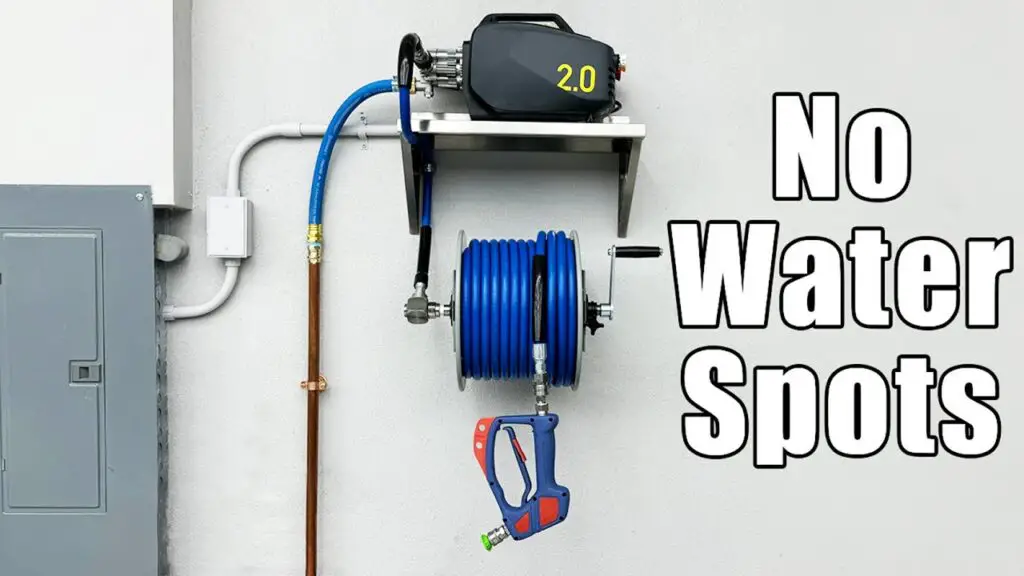
A wall mounted pressure washer is one of those garage upgrades that can turn pressure washing from a chore into something you can start in a minute. Instead of rolling a machine out of storage, untangling the pressure hose, connecting everything, and putting it all away afterward, the washer stays permanently mounted and ready for use.
Modern systems often combine an electric pressure washer, long high-pressure hose, reel, spray gun storage, and quick-connect fittings into a compact installation. Some all-in-one units even integrate the washer and retractable reel into a single enclosure.
But wall-mounted pressure washers aren’t automatically better than portable models. They trade portability and, sometimes, maximum cleaning power for convenience and organization.
Table of Contents
What Is a Wall-Mounted Pressure Washer?
A wall-mounted pressure washer is essentially a pressure washer designed to remain in a fixed location.
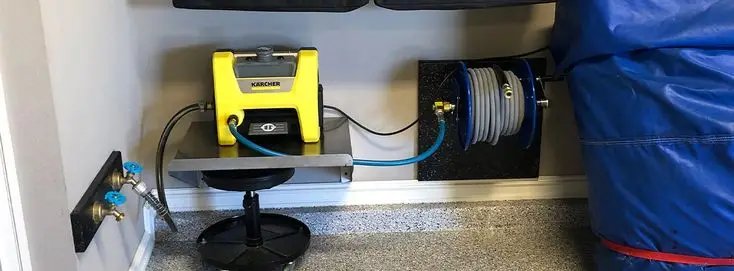
The machine may be mounted directly to a garage wall or installed on a dedicated shelf or mounting plate. A high-pressure hose reel is normally positioned beside or underneath it.
A typical installation looks like:
Water supply → pressure washer → short jumper hose → hose reel → high-pressure hose → spray gun → nozzle
Custom installations commonly use a short high-pressure jumper hose between the washer and reel, while quick-disconnect fittings make servicing or replacing components easier.
This arrangement is particularly popular for garages, workshops, detailing bays, car washes, and homeowners who frequently wash vehicles.
Why Wall Mount a Pressure Washer?
Convenience is the biggest advantage.
With a portable pressure washer, even a quick five-minute cleaning job can involve getting the machine out, connecting the garden hose, connecting the pressure hose, plugging in the machine, and untangling everything.
A permanent installation eliminates much of that preparation.
The hose simply pulls from the reel, the water and power are switched on, and you’re ready to wash.
Wall mounting also keeps hoses and equipment off the floor. Proper hose storage reduces clutter and helps prevent hoses from being stepped on or run over.
For people who wash cars several times per month, that difference can be significant.
Types of Wall-Mounted Pressure Washers
There are two main approaches.
- All-in-one systems contain the pressure washer and hose-management system in one package. Installation is relatively straightforward because most of the plumbing between components has already been designed by the manufacturer.
They’re usually the best option for homeowners who simply want something neat and convenient.
- Custom wall-mounted systems use a conventional pressure washer combined with a separate shelf, hose reel, fittings, jumper hose, gun holder, and accessories.
These require more planning but offer much greater flexibility. Components can also be upgraded independently.
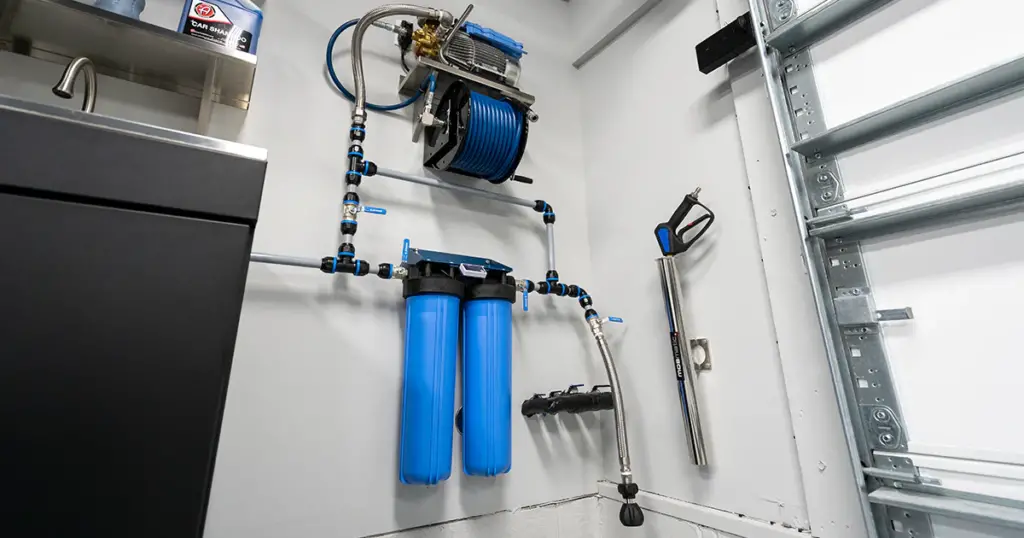
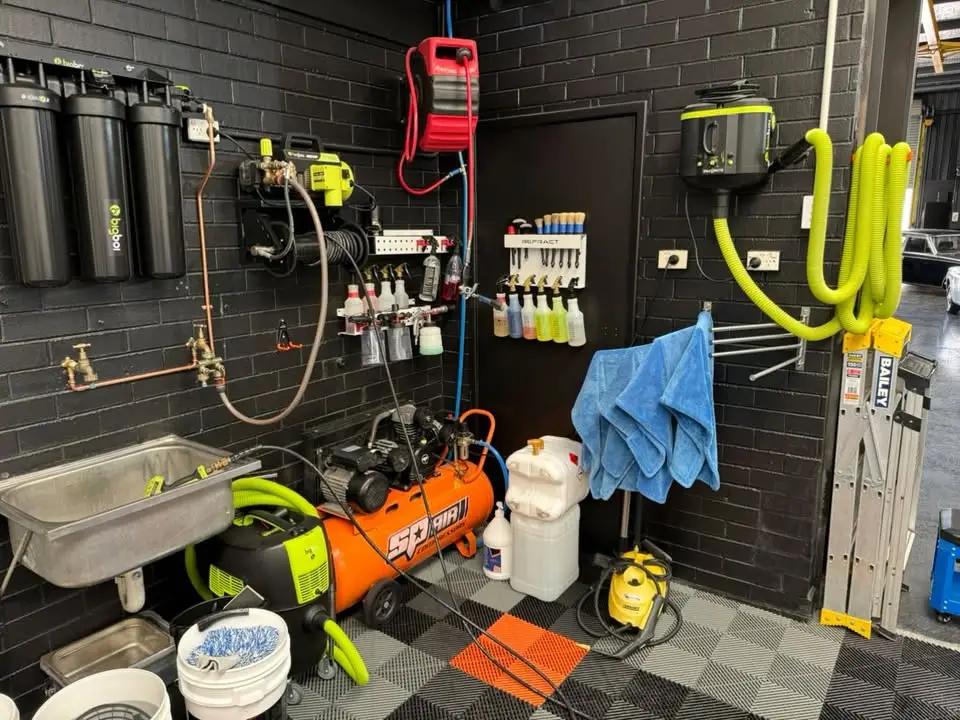
A custom setup might include a professional hose reel, 50–100 ft pressure hose, stainless-steel quick connects, swivel spray gun, foam cannon, nozzle rack, and even a water filtration or deionization system.
Enthusiast detailing installations frequently follow this approach.
PSI vs. GPM: What Actually Matters?
Pressure washers are normally advertised primarily by PSI—pounds per square inch.
But PSI isn’t the whole story.
PSI represents pressure, while GPM represents water flow in gallons per minute.
Pressure helps break contamination away from a surface. Water flow carries the loosened dirt away.
This is why two machines advertising similar PSI can feel very different during actual cleaning.
For routine household work and vehicle washing, extremely high pressure generally isn’t necessary. Electric pressure washers typically provide less output than large gasoline-powered machines, but they’re quieter, easier to maintain, and particularly well suited to permanent garage installations.
For car detailing especially, good water flow, a quality hose, and convenient accessories can be more valuable than chasing the largest advertised PSI number.
Hose Length
Hose length is one of the most important specifications in a wall-mounted system because the machine itself can’t follow you.
- For a small garage, 50 ft may be sufficient.
- For most driveways, 65–100 ft provides considerably more flexibility.
- A 100-foot hose can allow you to walk around multiple vehicles or reach different areas of a driveway without relocating equipment.
Some dedicated wall-mount systems are designed around reels capable of storing up to 100 ft of 3/8-inch pressure hose.
Before buying, measure from the planned mounting location to the farthest place you’re likely to clean—and remember that you’ll need enough hose to move around obstacles rather than simply reach them in a straight line.
Retractable vs. Manual Hose Reels
A retractable reel is the convenience option.
Pull the hose to the required length, use it, give it a tug, and the spring mechanism retracts it.
This makes quick vehicle washing extremely convenient.
A manual reel requires turning a handle to retrieve the hose. It isn’t quite as effortless, but quality manual reels tend to be mechanically simple and durable.
For occasional residential use, retractable reels are excellent.
For frequent detailing or professional use, a heavy-duty manual or commercial reel can make more sense because the reel mechanism can be serviced independently.
Quick-Connect Fittings
Quick connects are a small upgrade that dramatically improves the experience.
Instead of threading hoses and accessories together every time, they allow components to snap into place.
Useful locations include:
- Water inlet
- Pressure washer outlet
- Hose reel
- Pressure hose
- Spray gun
- Wand
- Foam cannon
Stainless-steel fittings are particularly popular in permanent installations because of their corrosion resistance.
Just make sure every fitting is rated for at least the maximum working pressure of your system.
Spray Gun and Swivel
The spray gun is another component worth paying attention to.
Long factory pressure-washer guns are fine for cleaning concrete or siding, but a short gun is often more convenient for detailing vehicles.
Adding a swivel between the hose and gun can also reduce hose twisting as you walk around a vehicle.
It sounds like a minor feature, but with a 50- or 100-foot hose it can noticeably improve usability.
Nozzles
Most pressure washers use interchangeable spray tips.
Common spray patterns include:
0° — Red: Extremely concentrated stream. Rarely needed for ordinary residential cleaning and capable of damaging surfaces.
15° — Yellow: Aggressive cleaning for durable surfaces.
25° — Green: General-purpose cleaning.
40° — White: Wider, gentler spray that’s useful for rinsing and many vehicle-cleaning applications.
Soap nozzle — Black: Designed for detergent application.
Always start with a wider spray pattern and increase aggressiveness only when necessary.
High-pressure water can damage paint, wood, seals, siding and even concrete if the wrong nozzle or distance is used.
Foam Cannon Compatibility
Anyone buying a wall-mounted washer primarily for detailing should check foam-cannon compatibility.
A foam cannon mixes pressure-washer water with car shampoo and air to produce thick foam.
Most quality cannons use a 1/4-inch quick-connect fitting.
However, foam performance also depends on the pressure washer’s flow rate and the foam cannon’s internal orifice.
A machine with relatively low water flow may require a smaller foam-cannon orifice to produce thick foam.
Installation
Installation deserves more attention than it sometimes gets.
A wall-mounted washer plus reel and hose can place substantial weight and pulling force on the wall.
The mounting surface therefore needs to be structurally sound.
For framed walls, mounting into studs is generally preferable. Concrete and masonry require appropriate anchors and drill bits.
Wall-mounted reel instructions also emphasize that the mounting structure needs to support not just the reel but the hose and forces generated while pulling it.
The ideal location should be close to:
Water + electrical outlet + drainage + the area being cleaned.
Don’t mount the system somewhere that requires an extension cord every time you use it.
Water Supply
Pressure washers need adequate incoming water flow.
A pressure washer can’t create water—it can only pressurize the water supplied to it.
If the household supply can’t provide enough flow, the machine may experience pressure fluctuations or pump problems.
Before installation, check the manufacturer’s minimum inlet-flow requirements.
Also avoid running the machine without water. Pressure-washer pumps depend on water for cooling and lubrication.
Electrical Requirements
Most residential wall-mounted pressure washers are electric.
Check the machine’s voltage and current requirements before installation.
Ideally, the outlet should be properly grounded and protected by a GFCI/RCD-type safety device appropriate for wet environments.
Avoid undersized extension cords because voltage drop can cause overheating and poor motor performance.
One advantage of a permanent installation is that the electrical connection can be planned correctly instead of relying on temporary extension cords.
Where Should You Mount It?
A garage is usually the ideal location.
It protects the machine from direct sunlight, rain, snow, and freezing conditions while keeping it close to vehicles and the driveway.
A good mounting height also matters.
You should be able to reach the reel and controls comfortably without having the pressure hose dragging across shelving or other equipment.
Leave enough space around the machine for ventilation and maintenance.
Outdoor Installation
Some wall-mounted pressure washers are marketed for outdoor installation, but don’t assume every unit can remain permanently exposed.
Check the manufacturer’s weather-resistance rating.
Even if the housing tolerates rain, prolonged UV exposure and freezing temperatures can shorten the life of hoses, seals, plastic components, and fittings.
Freezing is particularly dangerous because water trapped inside the pump can expand and damage it.
In cold climates, indoor installation is generally preferable.
Cleaning Performance
A good wall-mounted electric pressure washer can handle most routine residential cleaning.
Typical jobs include:
Vehicles: Excellent.
Motorcycles and bicycles: Excellent when appropriate pressure and distance are used.
Patio furniture: Excellent.
Decks: Very good, although excessive pressure can damage wood.
Siding: Very good when used carefully.
Driveways: Good, although cleaning large concrete areas can take longer with lower-flow machines.
Heavy commercial cleaning: Usually not ideal unless you’re using a professional pump-and-motor system.
Portable gas pressure washers generally remain better for jobs where maximum pressure and flow are more important than convenience.
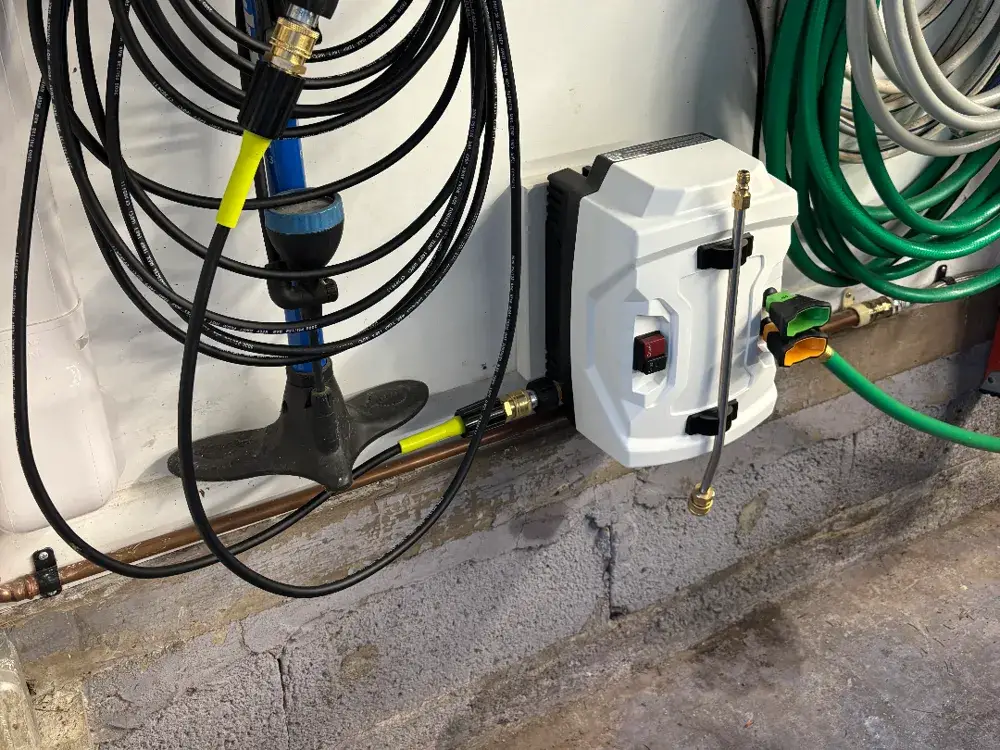
Wall-Mounted Pressure Washer for Car Detailing
This is arguably where the concept makes the most sense.
Imagine washing your car:
Pull out the pressure hose, connect your gun, turn on the machine, wash the vehicle, retract the hose.
That’s essentially the entire setup process.
No machine rolling around the driveway and no electrical cord following you around the vehicle.
Detailing enthusiasts who’ve built permanent installations frequently cite reduced setup effort as one of their biggest advantages.
If detailing is your primary purpose, prioritize:
GPM → hose quality → hose length → reel quality → short gun/swivel → quick connects → foam cannon compatibility.
Maximum PSI should be farther down the list.
Maintenance
Electric wall-mounted pressure washers generally require relatively little maintenance, but they aren’t maintenance-free.
Periodically inspect the pressure hose for abrasions, bulges, cracks, or leaks.
Check quick-connect O-rings and replace damaged ones.
Clean the water-inlet filter.
Inspect nozzles for blockage.
Check fittings and reel connections for leaks.
Drain the system before freezing weather.
If storing the machine through winter, follow the manufacturer’s winterization procedure. Pump-protection fluid may be recommended for some models.
Also avoid leaving the machine pressurized unnecessarily.
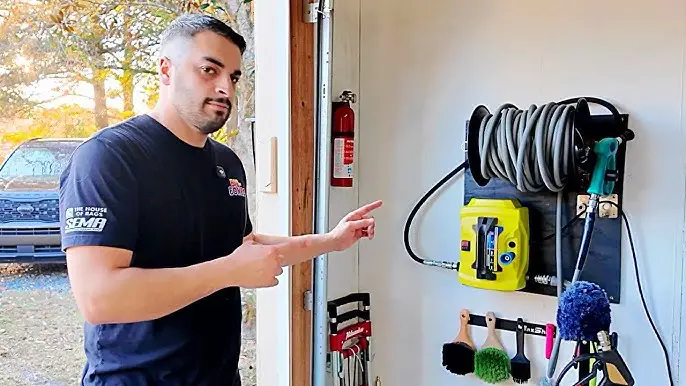
Common Problems
Pressure Pulsates
The most common causes include inadequate water supply, air entering the system, a clogged inlet filter, partially blocked nozzle, or hose restrictions.
Pressure Is Lower Than Expected
First verify the nozzle.
A worn or oversized nozzle can dramatically reduce operating pressure.
Also check water flow, connections, filters, and hose condition.
Hose Leaks at Quick Connect
Usually the O-ring is damaged or missing.
Replacing an inexpensive O-ring often solves the problem.
Reel Doesn’t Retract Properly
Retractable reels depend on an internal spring mechanism.
If retraction becomes weak, check for hose tangles and contamination before assuming the reel has failed.
Pressure Washer Starts and Stops
Small electric pressure washers often use total-stop systems that switch the motor off when the trigger is released.
Repeated cycling when you’re not pulling the trigger, however, may indicate a leak somewhere downstream.

Pros
- A well-designed system also encourages more frequent use simply because washing something doesn’t require setting up an entire machine.
- There’s almost no setup time, hoses aren’t scattered around the garage, the pressure washer doesn’t occupy floor space, and accessories can remain permanently organized.
- The biggest strengths of a wall-mounted pressure washer are convenience and organization.

Cons
- The biggest limitation is obvious: it’s permanently installed.
- You can’t easily take the machine to another side of the property.
- Another consideration is repairability.
- Installation also costs more because you may need a mounting system, reel, long hose, fittings, plumbing, and electrical work.
- A modular setup is more complicated initially but allows individual components to be replaced.
Wall-Mounted vs. Portable Pressure Washer
| Feature | Wall-Mounted | Portable |
|---|---|---|
| Setup time | Excellent | Average |
| Storage | Excellent | Requires floor space |
| Hose management | Excellent | Varies |
| Portability | Poor | Excellent |
| Car detailing | Excellent | Very good |
| Heavy-duty cleaning | Good | Often better |
| Installation | Required | Minimal |
| Upgrade potential | Excellent with modular setup | Good |
| Convenience | Excellent | Good |
Neither design is universally better.
The correct choice depends on how you use it.
What to Look for When Buying
Rather than choosing whichever machine advertises the largest PSI number, look at the entire system.
Important specifications include:
Realistic operating pressure: Ignore exaggerated marketing numbers when possible.
GPM: More water flow generally improves rinsing and cleaning speed.
Hose length: 50–100 ft is ideal for many permanent installations.
Hose diameter: Heavy-duty systems frequently use 3/8-inch hose.
Reel construction: The reel may receive more physical abuse than the pressure washer itself.
Quick-connect compatibility: Standard fittings make upgrades easier.
Pump design: Look for a manufacturer with available replacement parts.
Total-stop system: Convenient for residential electric washers.
Warranty: Particularly important with integrated washer/reel designs.
Replacement parts: Check whether hoses, guns, fittings, and reels can be replaced separately.
DIY Wall-Mounted Setup vs. Complete System
A complete system wins on simplicity.
You buy one package, mount it, connect water and electricity, and start using it.
A DIY system wins on quality and repairability.
You can combine a pressure washer you trust with a professional reel, premium hose, stainless fittings, swivel gun, foam cannon, and accessory holders.
Dedicated mounting systems can accommodate separate washers and reels, including configurations where the reel holds around 100 ft of pressure hose.
For casual homeowners, an integrated unit is usually easier.
For serious car-detailing enthusiasts, a modular setup is often the better long-term investment.
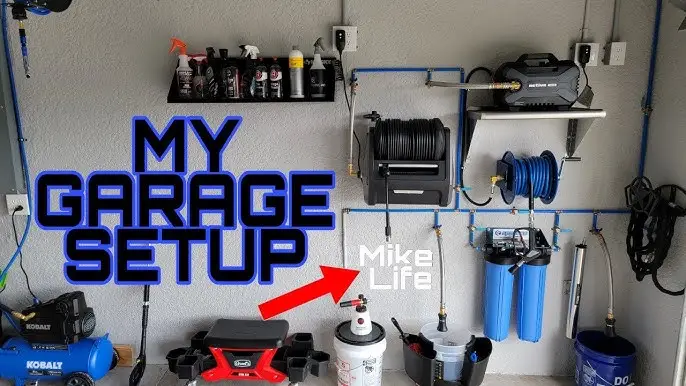
Who Should Buy One?
A wall-mounted pressure washer makes the most sense if you:
Wash your car frequently, have a permanent garage or workshop, dislike setting up a portable washer, want a clean garage floor, regularly clean a driveway or patio, or want a dedicated detailing station.
It makes less sense if you:
Only pressure wash once or twice per year, need to clean multiple distant areas of a large property, don’t have a permanent mounting location, or require commercial-level cleaning power.
READ ALSO: Best Pressure Washer Hose for Drone Cleaning