
Hose Length
Choosing the right garden hose length can make watering your lawn, washing your car, or cleaning your patio much easier. A hose that’s too short limits your reach, while one that’s unnecessarily long can be heavy, difficult to store, and reduce water flow.
Table of Contents
What Is the Standard Garden Hose Length?
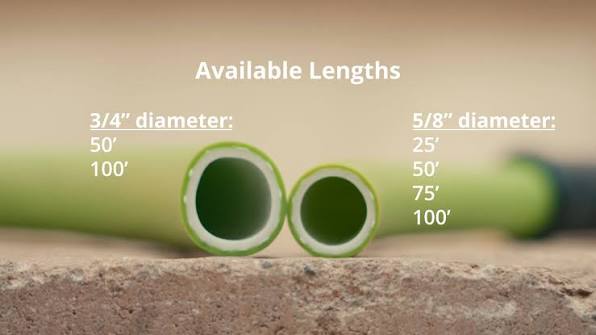
Garden hoses are commonly sold in four standard lengths: 25, 50, 75, and 100 feet. Longer options, including 150 and 200 feet, are available for specialized applications.

25 feet (7.6 m)
Best for patios, balconies, and nearby plants.

50 feet (15.2 m)
Best all-around choice for smaller residential yards.

75 feet (22.9 m)
Good for medium yards and longer watering routes.

100 feet (30.5 m)
Suitable for large yards and distant watering areas.
Garden Hose Length Comparison
| Hose length | Best for | Main advantage | Main drawback |
|---|---|---|---|
| 25 ft | Small patios, balconies | Lightweight | Limited reach |
| 50 ft | Small yards, car washing | Balanced size | May not reach far corners |
| 75 ft | Medium yards | Extra flexibility | More weight |
| 100 ft | Large yards | Extended reach | Bulkier, greater friction loss |
| 150–200 ft | Large properties | Long-distance coverage | Heavy, potential flow reduction |
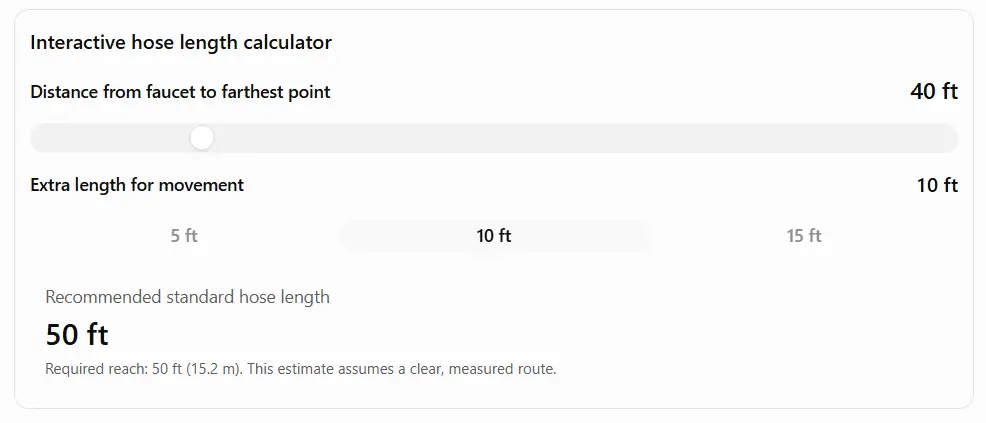
For many homeowners, a 50-foot, 5/8-inch diameter garden hose offers an excellent balance of reach, handling, and water delivery.
How to Choose the Right Hose Length
Does Hose Length Affect Water Pressure?
Yes. As water travels through a hose, friction creates pressure loss. The longer the hose, the greater the potential pressure drop.
However, the actual reduction depends on hose diameter, flow rate, faucet pressure, fittings, and connected equipment.
For example, a 100-foot hose generally creates more friction resistance than a 50-foot hose of the same diameter when delivering the same flow rate.
Illustration: Relative friction loss at equal flow and diameter
Illustrative friction loss indexed to 25 feet at the same water flow and hose diameter. Not measured PSI values.
0×2×4×6×25 ft50 ft75 ft100 ft
This comparison assumes identical hose diameter and water flow. Actual delivered flow may decrease as hose length increases.
To maintain better water delivery, use the shortest practical hose, avoid kinks, and consider a larger internal diameter for longer runs.
Hose Length vs. Diameter: What’s More Important?
Both matter, but they affect performance differently.
- 1/2-inch diameter: Lightweight and suitable for small gardens and everyday watering.
- 5/8-inch diameter: A versatile option for most residential watering tasks.
- 3/4-inch diameter: Better suited to high-flow applications, long hose runs, and larger irrigation systems.
A 100-foot hose with a 3/4-inch diameter may deliver more water than a narrower hose of the same length under comparable conditions, although it will typically be heavier and harder to handle.
Review of Different Garden Hose Types

Rubber hoses
- Durable, flexible, and suitable for frequent outdoor use. Particularly useful for demanding jobs, though often heavier and more expensive.

Vinyl hoses
- Affordable and typically lightweight. Good for occasional watering, but basic models may kink more easily or become less flexible in cold conditions.
![Tuyau d'arrosage extensible Tuyau d'arrosage de jardin de 25 à 100 pieds, connecteur rapide, tuyau extensible, nettoyage de [H3279] - Cdiscount Jardin](https://images.openai.com/static-rsc-4/yJhapIo1TRXCs0r8G8vw4vMBh0O4d0plpS56m1jMwLXVTZAS7_1k2FdmDfoO33k84CapNcfNZgXnP5-bZSwh9ijhIIMnawlIUo25pw8suHOuTDcUBnEWDmAl-36yXl27GMwXJz7BQyKc2EHNjl2TB-8IzAVqC6LdqY98pRwWWOE?purpose=inline)
Expandable hoses
- Compact and easy to store. Their advertised length usually refers to their expanded working length under suitable water pressure. Durability varies by model.

Metal hoses
- Resistant to many common abrasions, punctures, and animal bites. However, flexibility, weight, and water-flow capacity depend on their construction.
Advantages and Disadvantages of Longer Hoses

Pros
- Reaches distant areas
Fewer faucet changes
Useful for larger properties
Flexible watering coverage

Cons
- Greater weight
More storage space
More difficult to maneuver
Additional friction loss
How to Extend Your Garden Hose
If your existing hose is too short, you can connect another section using compatible hose fittings.
Make sure both hoses have matching connector standards, use properly seated washers, and avoid unnecessary adapters that could restrict flow.
For occasional long-distance watering, connecting two shorter hoses can be more practical than using one long hose for every job.
For frequent use, a correctly sized single hose and a quality hose reel may offer more convenience.
How to Maintain Your Hose
Proper care can extend the lifespan of almost any garden hose.
- Drain remaining water after use.
- Avoid sharp bends and tight kinks.
- Store the hose on a reel or holder.
- Keep it away from prolonged direct sunlight when possible.
- Disconnect, drain, and protect it from freezing temperatures.
- Inspect fittings and washers regularly for leaks.
Frequently Asked Questions
Is a 50-foot hose long enough?
For many small and medium residential yards, yes. However, the faucet location and layout determine whether it will reach every area.
Does a longer hose use more water?
A longer hose holds more water internally, but it doesn’t automatically mean you consume more water during watering. Actual consumption depends primarily on flow rate and operating time.
Can I connect two 50-foot hoses?
Yes. Connecting two 50-foot hoses creates approximately 100 feet of total hose length. Use compatible, leak-free connectors.
What is the best hose length for washing a car?
A 25- to 50-foot hose generally works well when the vehicle is parked near the faucet. Larger driveways may require 75 feet or more.
Final Verdict: What Hose Length Is Best?
| Category | Recommended choice |
|---|---|
| Best for small spaces | 25 ft |
| Best overall for many homes | 50 ft |
| Best for medium yards | 75 ft |
| Best for large yards | 100 ft |
| Best for extended reach | 150–200 ft, with flow requirements checked |
The 50-foot garden hose is a strong all-around choice for many homeowners, especially when paired with a 5/8-inch internal diameter.
However, the best hose isn’t necessarily the longest or most expensive. It’s the one that comfortably reaches your watering areas while maintaining adequate water flow and remaining easy to handle and store.
Ultimately, measuring your actual watering distance before buying is the most reliable way to choose the right hose length.
READ ALSO: How to Roll Up a Hose?